
Every application needs computing resources to run.
Whether you’re building a SaaS product, an AI agent, a RAG pipeline, or a model-serving infrastructure, your code needs somewhere to execute.
But here’s an interesting question:
Do we need to manage the serve ourself , or can we let a cloud providers handle most of that responsibility?
That question leads us to the two fundamental approaches to application deployments:
Serverful architecture and Serverless architecture
Understanding the difference isn’t just about knowing two cloud computing terms. It’s about learning how to make better engineering decisions based on workload, cost, performance, and operational complexity.
Let’s start from the first principles.

1. Before Architecture, Understand the Problem
Imagine you’re building a clinic appointment booking application.
A patient opens your website, selects a doctor, chooses an available time slot, and confirms the appointment.
What happens behind the scenes?
- The browser sends an HTTP request.
- The backend receives the request.
- The application validates the appointment details.
- The backend queries the database to check availability.
- The database stores the appointment.
- The backend returns a response to the browser.
Your application needs a computing environment to execute its business logic.
That environment could be a virtual machine, a physical server, a container, or a managed cloud execution service.
This brings us to our first principle:
An application needs compute resources. Architecture determines how those resources are provisioned, managed, scaled, and paid for.
What exactly is a server?
A server is a computer or computing process that provides services to other computers, called clients.
Your laptop running a FastAPI application is technically capable of acting as a server.
So is a virtual machine rented from a cloud provider.
The important distinction isn’t whether a server exists. It’s how much responsibility you take for managing it.
What Is Serverful Architecture?

Serverful architecture is an approach in which you manage a significant portion of the computing environment where your application runs.
For example, you rent a virtual machine, install Linux, configure Python, deploy a FastAPI application, and keep it running.
A typical architecture looks like this:
Client → Load Balancer → Application Server → Database
The load balancer is optional, particularly for smaller applications.
In this setup, you have greater control over the underlying environment.
You can choose the machine’s CPU and RAM, configure the operating system, install dependencies, run background workers, and tune the application according to your requirements.
However, greater control comes with greater responsibility.
What do you manage?
Depending on the hosting model, you may be responsible for:
- Selecting CPU, RAM, storage, and networking resources.
- Installing and configuring the operating system and runtime.
- Keeping the application process running.
- Applying security patches and configuring access controls.
- Monitoring CPU, memory, disk usage, and application logs.
- Planning capacity and implementing scaling and recovery mechanisms.
The cloud provider may still manage the physical hardware. Serverful does not necessarily mean owning a physical server.
For example, Amazon EC2 provides virtual servers that you can configure and operate.
How does scaling work?
Suppose your application initially receives 100 requests per day.
A small virtual machine might be sufficient.
Now imagine that your product becomes popular and starts receiving thousands of simultaneous requests.
Your application may run out of CPU, memory, database connections, or network capacity.
You can address this in two fundamental ways.
Vertical scaling: Increase the resources of an existing machine.
Horizontal scaling: Run multiple application instances and distribute traffic between them.
Both approaches have trade-offs. Vertical scaling has practical resource limits, while horizontal scaling introduces additional complexity around load balancing, shared state, database connections, and failure handling.
Scaling can be automated, but you still need to configure or choose the mechanisms responsible for it.
When does serverful make sense?
Serverful infrastructure is worth evaluating when:
- Your application runs continuously.
- You need extensive control over the runtime or operating system.
- You have long-running background workers.
- You need specialized compute or persistent GPU memory.
- You have predictable workloads and can plan capacity efficiently.
For example, an AI inference service running vLLM may keep a large language model loaded in GPU memory. A continuously provisioned GPU instance can be a practical choice when inference traffic is sustained.
The key advantage is control. The trade-off is operational responsibility.
What Is Serverless Architecture?
Serverless architecture takes a different approach.
Instead of managing the underlying servers directly, you deploy your application to a managed platform that handles much of the infrastructure provisioning, execution, and scaling.
You focus more on application logic and less on server administration.
The term serverless can be misleading.
Serverless does not mean there are no servers. It means you don’t manage the servers in the traditional way.
The servers still exist. The cloud provider manages more of the underlying infrastructure for you.
Two common forms of serverless computing are function-based execution and serverless containers.
Function-based execution
You write a function that executes in response to an event.
For example, when a user uploads a PDF, a function might extract its text and save the result.
Services such as AWS Lambda provide this execution model.
The workflow looks like this:
Event → Function Execution → Result → Persistent Storage
You don’t need to maintain a dedicated virtual machine just to wait for that event.
Serverless containers
Serverless doesn’t always mean writing small functions.
Platforms such as Google Cloud Run can execute containerized applications while managing much of the underlying infrastructure.
You could package a FastAPI application into a container and deploy it without directly managing a virtual machine.
This is useful when you want to retain a familiar application structure while reducing infrastructure administration.
How does serverless execution work?
Consider a document-processing application.
- A user uploads a PDF.
- An event triggers a function or container-based worker.
- The application extracts the document’s text.
- The result is saved to durable storage.
- The execution environment may be reused or shut down when no longer needed.
The platform handles much of the execution infrastructure.
Depending on the service and configuration, it may create additional execution environments when demand increases and scale down when demand falls.
However, scaling isn’t unlimited. Concurrency settings, quotas, execution duration, downstream service capacity, and provider-specific limits still matter.
Why can serverless be cheaper?
Imagine an application that processes requests only occasionally.
A continuously provisioned virtual machine may incur compute charges even when no requests arrive.
With a suitable serverless service, compute charges may depend on requests and execution duration. Some platforms can also scale to zero.
This can be attractive for applications with unpredictable or intermittent traffic.
But serverless isn’t automatically cheaper.
A high-volume application, an expensive database, large network transfers, repeated initialization, or minimum-instance requirements can change the economics.
The correct decision requires comparing the complete cost of running the system.
Serverful vs. Serverless: What’s the Actual Difference?
Let’s compare them across the dimensions that matter in engineering.

Neither approach automatically guarantees better security, reliability, or scalability.
Those properties depend on application design, infrastructure configuration, monitoring, data management, and operational practices.
The real question is not which architecture is universally superior.
It’s which architecture fits your workload.
Let’s Understand the Cost With a Simple Example
Suppose you’re choosing between a virtual machine and serverless compute.

Assume the following hypothetical pricing:
- A virtual machine costs ₹1,500 per month.
- Serverless compute costs ₹0.01 per request.
These numbers are for illustration only, not actual cloud pricing.
At 10,000 requests per month, serverless compute costs ₹100 under our assumption.
At 100,000 requests, it costs ₹1,000.
At 200,000 requests, it costs ₹2,000.
The virtual machine remains at ₹1,500 in this simplified example.
The break-even point is 150,000 requests per month.
Below that point, serverless compute is cheaper under these assumptions. Above it, the virtual machine is cheaper.
However, this is not a complete production cost comparison.
It excludes database costs, networking, storage, logging, availability requirements, scaling overhead, and engineering time.
Real pricing also varies by provider, region, memory allocation, execution duration, and service configuration.
The lesson is simple:
Don’t optimize for the lowest advertised compute price. Optimize for the total cost of delivering the required performance and reliability.
Four Real-World Scenarios
Let’s apply these principles to different workloads.
Scenario 1: A SaaS application
Imagine you’re building a job-matching platform with a React frontend, a FastAPI backend, and PostgreSQL.
You want to launch quickly, validate the product, and avoid spending weeks managing infrastructure.
A managed application platform or serverless container service can be a sensible starting point.
You can deploy your API, use a managed database, and add background workers as the product grows.
You don’t need to introduce complex infrastructure before you have evidence that you need it.
Scenario 2: A RAG system
Consider a retrieval-augmented generation system that ingests documents, generates embeddings, retrieves relevant chunks, reranks results, and produces answers.
Not every component has the same workload.
The API may handle short requests. Document ingestion may take minutes. Embedding generation may require substantial compute. Model inference may need a GPU.
A hybrid architecture is often worth evaluating.
Use managed execution for lightweight, event-driven tasks, durable queues for background processing, and dedicated compute where sustained workloads justify it.
This allows each component to scale independently.
Scenario 3: A continuously running AI model
Suppose you host an open-weight language model using vLLM.
The model may require substantial GPU memory, and loading its weights can be expensive in terms of time and resources.
If requests arrive continuously, keeping the model loaded in a dedicated inference service may be more practical than repeatedly creating execution environments.
For intermittent inference, managed or serverless GPU offerings may still be attractive.
The right decision depends on model size, request frequency, latency requirements, GPU utilization, and cost.
Scenario 4: Invoice processing
Imagine a customer uploads an invoice and expects the system to extract its fields, validate totals, and notify them when processing finishes.
This is an event-driven workload.
A useful design is:
Upload → Event → Queue → Processing Worker → Database → Notification
A queue separates accepting a job from completing it.
Workers can retry transient failures, while concurrency limits help protect external APIs and databases.
This architecture can use serverless functions, managed containers, or continuously running workers depending on the job duration and operational requirements.
The Most Important Concept: Hybrid Architecture
In production systems, you rarely need to choose one execution model for everything.
You can combine serverful compute, serverless functions, managed containers, databases, queues, and object storage.
Consider a RAG product processing millions of records.
Its architecture might include:
- Frontend: React application.
- API: FastAPI deployed to managed containers.
- Persistent storage: PostgreSQL and object storage.
- Vector retrieval: A vector database such as Qdrant.
- Background processing: A durable queue and ingestion workers.
- Model inference: A dedicated GPU-backed service when justified.
Why separate these components?
Because they have different resource requirements.
The API needs to respond quickly. Ingestion workers need to process large jobs reliably. The database needs durable storage. The inference service needs sufficient model memory and compute.
If all these workloads share one machine, a large ingestion job might compete with interactive API requests for resources.
Separating them creates opportunities for independent scaling, better fault isolation, and more precise cost control.
This leads to a deeper architectural principle:
Choose the execution model for each workload, not for the entire application.
Five Concepts You Should Understand Before Making the Decision
Statelessness and state
A stateless service can process a request without depending on data retained in a previous request’s local memory.
A stateful system relies on persistent sessions, ongoing process state, or information maintained across interactions.
Serverless applications often work best when durable state lives outside the execution environment.
For example, storing the only copy of a conversation in a function’s local memory is risky because the execution environment may disappear.
Store critical conversation history in a database instead.
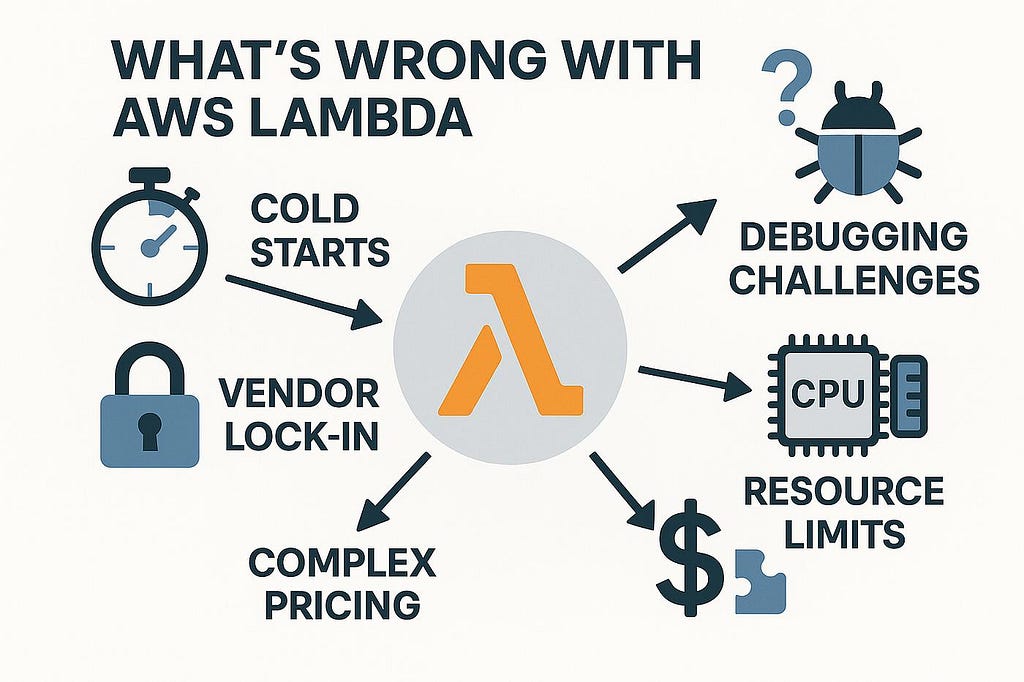
Cold starts
When a serverless platform needs to initialize an execution environment, the first request may experience additional latency.
This is called a cold start.
Cold starts can matter for interactive chat systems, low-latency APIs, large dependency packages, and applications that initialize machine-learning models.
Keeping instances warm or configuring minimum instances may reduce latency, but can introduce additional costs.
Concurrency
Concurrency is the ability to handle multiple requests or jobs at the same time.
Both serverful and serverless systems can support concurrent workloads.
However, adding more application instances doesn’t automatically solve every bottleneck.
Your database might have a connection limit. An external API might enforce a rate limit. Your application code might not be safe to execute concurrently.
Scaling compute without protecting downstream services can make the system less reliable.
Execution limits
Some serverless products impose limits on execution duration, memory, payload size, or concurrency.
For example, AWS Lambda’s standard execution model has a maximum invocation duration of 15 minutes.
Other platforms and orchestration systems support different execution models.
Before deploying a long-running task, understand the limits of the exact service you intend to use.
Vendor lock-in
Provider-specific functions, event systems, permissions, and databases can make migration more difficult.
You can reduce unnecessary coupling by keeping business logic separate from provider-specific code, using containers where appropriate, defining infrastructure as code, and designing retryable background jobs.
But portability is not free.
Sometimes a managed, provider-specific service is worth using because it substantially reduces operational complexity.
The objective is not to eliminate every dependency. It’s to make intentional trade-offs.
A Practical Decision Framework
Before choosing an architecture, ask five questions.
1. Is the workload continuous or intermittent?
Continuous, resource-intensive workloads deserve careful evaluation of provisioned compute. Intermittent workloads may benefit from serverless execution.
2. Does the workload need specialized hardware or extensive environment control?
GPU memory, custom drivers, special networking, and operating-system dependencies may favor dedicated compute.
3. How long does each task run?
Check execution-duration limits and failure behavior. Long-running tasks may require a queue, a worker service, or durable workflow orchestration.
4. How unpredictable is traffic?
Automatic scaling can be valuable when demand changes dramatically, provided downstream services can handle the resulting load.
5. What is the total cost?
Include compute, storage, networking, databases, logging, idle capacity, and the engineering effort required to operate the system.
Answering these questions gives you a much stronger basis for choosing an architecture than following a general recommendation.
How I Would Learn This as a Software Engineer
Reading definitions is useful, but architecture becomes much easier to understand when you observe real systems.
I’d follow this progression.
Stage 1: Run a server locally
Build a FastAPI application and understand HTTP, ports, processes, environment variables, logging, and database connections.
Stage 2: Deploy it to a virtual machine
Configure the runtime, HTTPS, a firewall, a process manager, and application monitoring.
Observe what happens when the application crashes or runs out of memory.
Stage 3: Deploy the application to a managed platform
Deploy the same API as a container. Observe how deployment, scaling, and infrastructure management differ.
Stage 4: Introduce serverless functions
Build a small event-driven task, such as processing an uploaded document. Measure execution time, initialization latency, and cost.
Stage 5: Build a hybrid system
Add a queue, background worker, durable storage, retries, and a separate inference endpoint.
Finally, load-test the system and compare its latency, reliability, and cost under different workloads.
Useful official documentation:
Conclusion
Serverful and serverless architecture are not opposing technologies. They are different ways of allocating responsibility between the application developer and the cloud platform.
Serverful infrastructure offers greater control and can work well for sustained, specialized workloads.
Serverless infrastructure reduces the burden of managing compute and can be especially useful for event-driven or variable workloads.
Hybrid architecture allows you to combine both approaches.
As an engineer, the goal isn’t to use the newest infrastructure trend.
It’s to understand the workload, identify the constraints, evaluate the trade-offs, and choose the simplest architecture that satisfies the requirements.
The best architecture isn’t the one with the most sophisticated infrastructure. It’s the one whose complexity is justified by the problem it solves.
Serverful vs. Serverless Architecture: Understanding the Trade-Offs From First Principles was originally published in Towards AI on Medium, where people are continuing the conversation by highlighting and responding to this story.