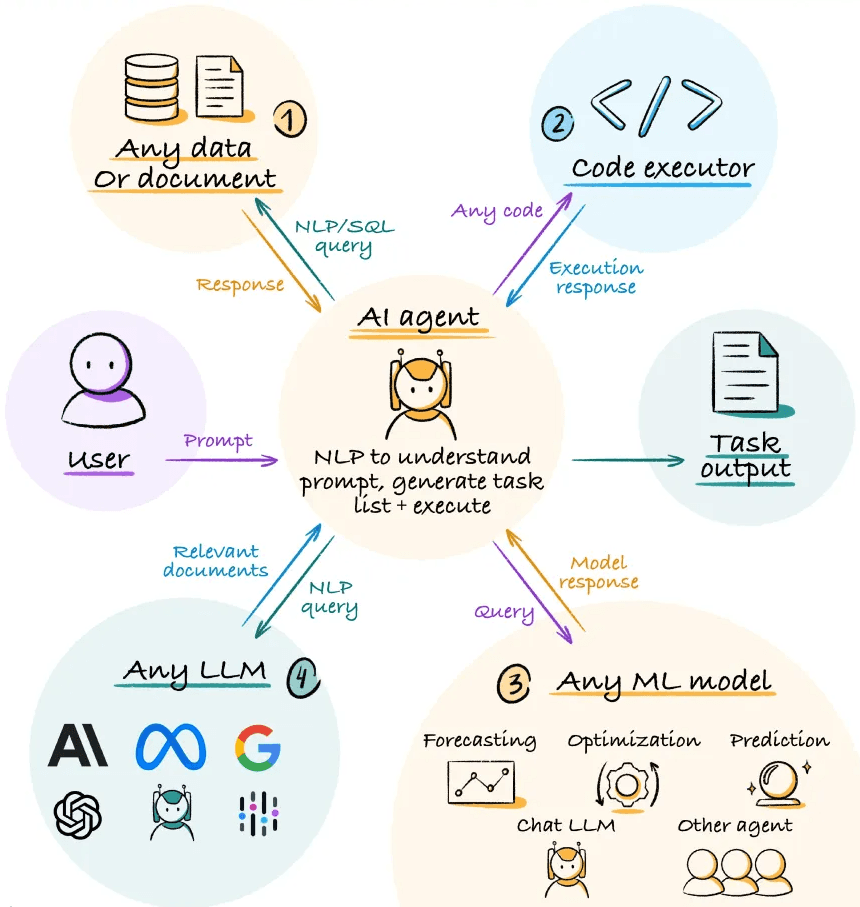
Agentic AI: Future Directions — Opportunities and Cybersecurity Applications

Artificial Intelligence had grown from being just a buzzword into being part and parcel of our lives. From voice assistants, recommendation algorithms to bots seamlessly intertwined with modern technology, this leaves the place to the next addition in the grand play- — Agentic AI.
In contrast, the system, while it achieves relative high-grade autonomy, must not be confused with agentic AI because agentic AI, being contrasted to classical AI, doesn’t need the system to process tasks under some predefined rules or supervised learning. Apart from its decision-making capability, it possesses adaptiveness to act upon the observed scenario for its goals instead of only analyzing and understanding it. Just imagine any AI system that can determine a goal, learn dynamically without being plugged, and support coordination in teamwork with humans without any flaws. That is what is ambitiously promised by Agentic AI.
Let’s dive deeper into the future of Agentic AI, its potential uses across various industries, and most importantly, its game-changing applications in cybersecurity.

What is Agentic AI, Exactly?
The line of artificial intelligence has evolved further into agentic AI. It is phenomenal when it comes to handling specific tasks, such as image recognition, natural language processing, or data analysis. But Agentic AI goes beyond all that. It emulates human agents in the capacity to perceive contexts, make decisions, and act without constant human intervention.
While a regular AI chatbot would respond to frequent queries coming from customers based on some preloaded scripts, its counterpart agentic AI chatbot could monitor customer sentiment in real time, decide on the best action — like offering a discount or escalating a complaint — and change its behavior to achieve better outcomes over time. This self-directed nature just opens the roof to a realm of applications everywhere, from hospitals to financial circles.

Future Examples of Agentic AI
The roles of Agentic AI are of such magnitude-so far, in fact, from what we come across. And now, let’s cover some futuristic utilizations:
1. Onboard Learning
Imagine studying where teachers, being custom AI tutors, literally learn and, therefore, adapt to the different pace at which each student learns and his other characteristics. Agentic AI might be that personal mentor who, in knowing one struggles at times, hones in on key points, even suggesting when breaks are required. It’s not just completing problems in the worksheet for the sake of filling up the pages; that’s understanding and teaching to love.
2. Health Transforming
Agentic AI could be extremely transformative in terms of healthcare change for the diagnosis and overall patient care. This is an AI system that may monitor vital signs of a patient in real-time, predict health risks, and act in due time to either alert the medical team or modify the treatment course. It might even coordinate with specialist doctors and advise alternative therapies on the basis of global trends in medical data.
3. Smart Cities and Urban Planning
Agentic AI will be pivotal in the smart cities’ management: optimizing from the flow of traffic to distribution of energy. For example, consider an AI that would change, independently, the lights on the grid of the traffic to increase congestion or to divert utilities during emergencies. It would result in clean, safer, and efficient living in towns and cities.
4. Creative Collaboration
While the ability to create has long been a human-like trait, it might soon change with Agentic AI becoming more of an assistant for artists, writers, and musicians alike while coming up with ideas, writing the draft of the stories, or even composing the music, going with the tides of a person’s creative imagination. Far from replacing that creativity, Agentic AI adds to it.
Agentic AI in Cybersecurity: The Ally
Now, let’s come to the realm of cybersecurity, where Agentic AI could have the most critical effect. In a world that is getting increasingly digital, cyber threats get increasingly sophisticated. Traditional security systems, robust as they might be, often rely on reactive measures: detection and response after the fact. Agentic AI can probably bring a revolution in proactive capabilities.
1. Threat Hunting and Neutralization
Agentic AI will be able to work alone as an autonomous threat hunter, constantly monitoring the networks for open vulnerabilities and suspicious activities. Instead of waiting for a human analyst to act on the matter, it will keep neutralizing threats in real time. If it identifies a phishing attack, it should immediately quarantine the compromised systems, trace back where the attack came from, and patch up the vulnerabilities.
2. Dynamic Defense Mechanisms
Among the greatest threats in cybersecurity lies the fact that cyber attackers are adapting their methods rapidly. Static defence systems usually have a lag when it comes to keeping up with that pace. Dynamic defense strategies agentic AI uses could outplay attackers by playing one step ahead of them using the latest known attack patterns.
3. Automating Incident Response
When a breach occurs, the response time is crucial. SANS Security Awareness Agentic AI could even automate the work-chain concerning incident response at large by next-generation automated impact-area calculation within the system flow, threat contained, and kicked off recovery for, in turn giving less downtime — hence reducing tangible potency in the outcome of cybercriminal hits in general.
4. Fraud Detecting
Financial transactions in which a number of the transactions appear strange imply fraud-marred transactions are possible within minutes by thanks which may operate autonomously using Agentic AI. Compared to conventional fraud detection models based on rule sets, the pattern recognition for new fraud trends may be dynamically changing by learning of Agentic AI.
5. Insider Threat Management
Not all cyber threats come from outside hackers. Insider threats, intentional or accidental, are a serious concern. Agentic AI would monitor employee behavior for deviations that could indicate unauthorized access to data or unusual login locations. It could, if acting in time, prevent data breaches before they escalate.
The Ethical Balancing Act
As with any powerful technology, Agentic AI has its share of ethical considerations. With such a system that acts autonomously, it raises questions of accountability and control. For example, who is accountable if an AI system makes a decision that leads to unintended consequences? How do we ensure its actions actually conform to human values and ethical standards?
These are concerns that particularly arise in cybersecurity. For example, how do we prevent Agentic AI from accidentally locking users out of systems or taking overtly sensitive actions to the point where operations could be severely disrupted? Ensuring Agentic AI remains a force for good is going to take a great deal of transparency, robust testing, and setting clear boundaries.
What’s Next for Agentic AI?
Undeniably, Agentic AI shall have an exciting but challenging future. There must be collaboration between researchers, technologists, policy-makers, and society in the development of such systems that can be trusted as transparent and ethical while autonomous. This might be a start for businesses and industries in exploring the potential of Agentic AI. Whether it is more delightful customer experiences, better operations, or strengthened cybersecurity defense, the possibilities are endless.
Conclusion: A New Brave World
Agentic AI represents the next wave of artificial intelligence, where machines increasingly think, learn, and act on their own. It holds the potential to transform industries, elevate lives, and even solve some of our most vexing problems.
Cybersecurity cannot have the stakes rise further. There have been constant efforts to sophisticate digital threats while pushing the boundary towards defenses being proactive, adaptive, and most intelligently sophisticated, too. What better allies might be like when agentic AI does its role of a fighter, unlike fighting only from an answering podium: one works within the first row to prevent the damage; one stands firmly for safeguarding a secure online future with open arms.
As we start this new wave of innovation in AI, one thing is sure: the journey will be as exciting as the destination. If we navigate it correctly, Agentic AI might just become our guide into a brighter and safer future. And so, I ask you: Is the world ready for Agentic AI? More precisely, are we ready to wield its power in its totality?