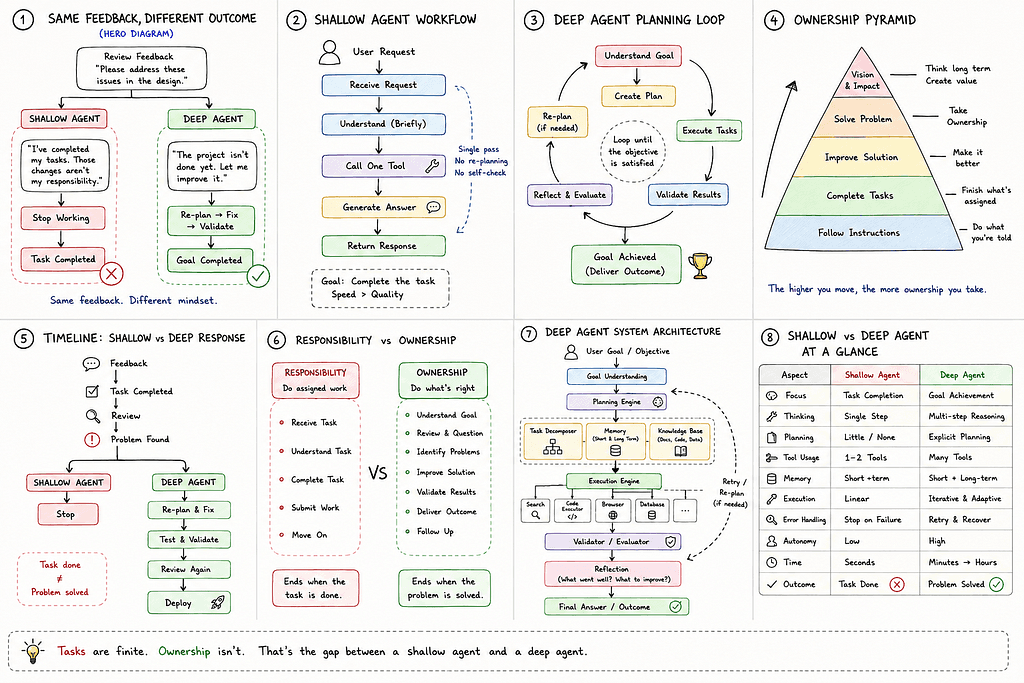
A few days ago, I took some time to go over our team’s latest system design. As I dig through the architecture, I spotted a handful of issues right away and threw out a few straightforward suggestions — adjustments that would make maintenance easier and actually help this thing scale.

Later, I circled back to check if anyone was working on those changes. The answer caught me off guard.
“I finished my tasks. That’s not my job.”
That line stuck with me.
On paper, sure, every box was checked. The assigned work was technically wrapped up. But if I’m being honest, the project itself? Not even close to finished.
That right there sums up the difference between a shallow agent and a deep agent.
Shallow Agents Just Finish the List
A shallow agent looks at their to-do list and thinks, “Okay, what am I supposed to do? Am I finished yet? Am I clear to move on?” As soon as everything’s checked off, they’re done. That’s where their job ends.
For straightforward, repetitive jobs, this isn’t even a problem. Sometimes you just need stuff done, and if the task never changes, this is fine.
But when the real challenge goes beyond a set checklist, that’s when cracks start to show.
Deep Agents Care About the Real Outcome
A deep agent doesn’t stop at “task complete.” They keep going. Their questions hit a little deeper: “Did we actually reach our goal? Did my fix trigger something else to break? Should we rethink the plan now that we’ve learned more? Is there a better, smarter way to get there?”
For them, the outcome matters more than just ticking off tasks.
When feedback or new problems roll in, deep agents don’t shrug and say, “Not my job.” They adjust, improve, and keep pushing until the problem is actually solved.
It’s Not About Who’s Smarter
This isn’t about intellect or who’s got the flashiest skills. It comes down to how you approach work.
Shallow agents focus on what they’re told to do — and stop there. Deep agents want the problem solved, not just the work done. One says, “I’m finished.” The other says, “This actually works now.” There’s a real gap between the two.
Where Modern AI Fits In
Most AI right now can answer a question, draft some code, or spit out a summary. And that’s useful, for sure.
But the next wave? That’s starting to look different. These newer systems break down goals into smaller chunks, map out a plan, use lots of tools at once, double-check their work, keep learning, and adjust as things shift.
Suddenly, we’re not talking about a digital assistant handling a single request, but something closer to a real engineer running with a project from start to finish.
The Real Takeaway
That whole conversation reminded me: the true gap in engineering — and in AI — doesn’t have much to do with whether the task list is done. The real question is whether the actual problem is solved.
Tasks end. But ownership? That’s ongoing. And that right there is what really separates a shallow agent from a deep one.
for more such articles do follow me back and what are your thoughts on these topics do share it in the comments sections and do share it with your friends?